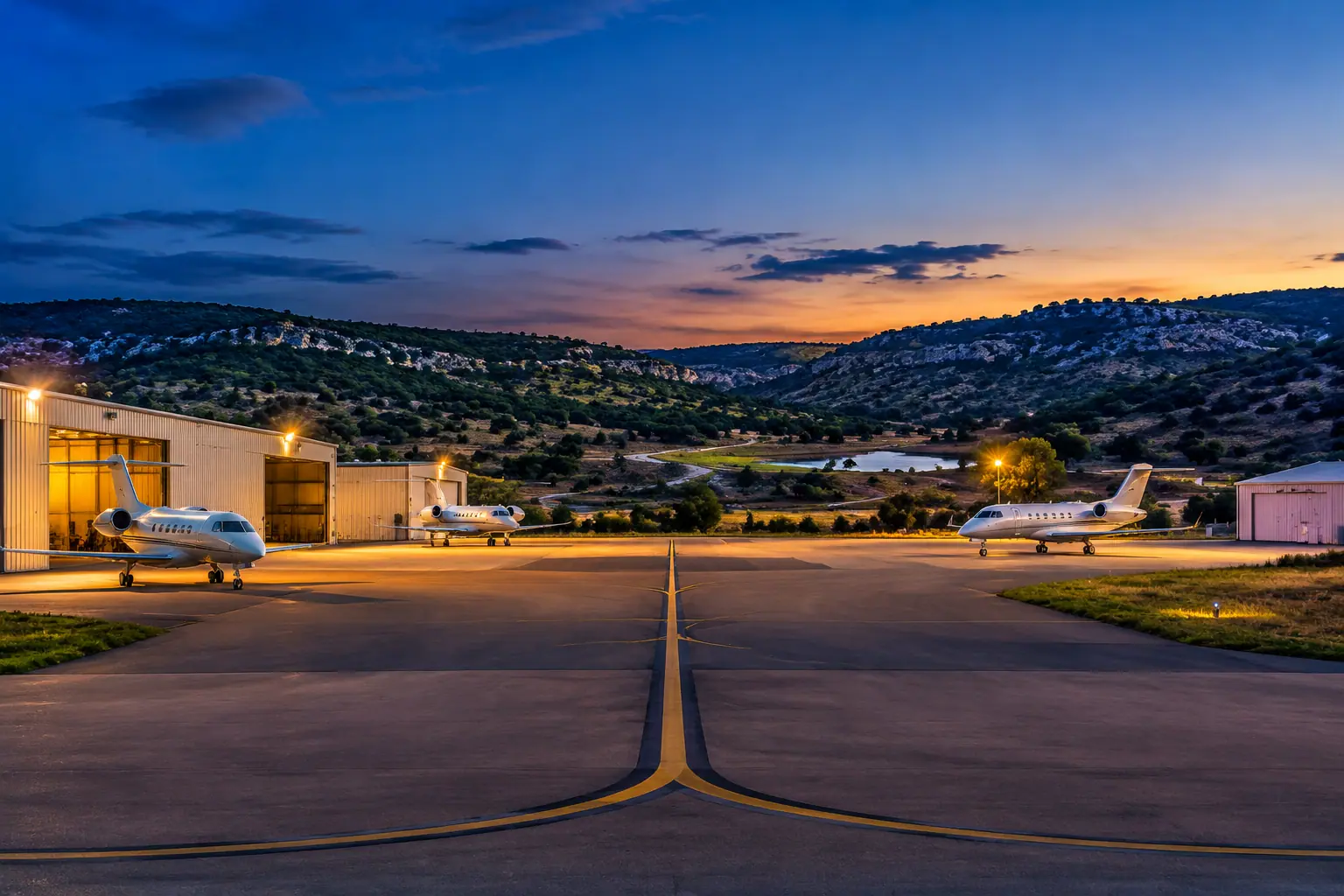
Private jet Nighthawks Nest guide
Private jet Nighthawks Nest service connects this small Texas field to your itinerary. The runway stretches 7,634 feet at 592 feet elevation. Plan around summer density altitudes that reach 3,700 feet.
Private jet Nighthawks Nest charters use a single runway that is 7,634 feet long at an elevation of 592 feet. That length supports midsize jets and many light jets, but the field has no control tower and no published instrument approach in our data, so arrivals depend on visual conditions. Pilots flying in should check notices for current status and plan a weather alternate. The airport sits in the Hill Country west of San Antonio, and ground transportation is limited, so arrange a car in advance.
For charter, Nighthawks Nest works as a departure or arrival point for lighter aircraft and shorter legs. With a 7,634-foot runway at 592 feet elevation, light and midsize jets can use Nighthawks Nest in cooler months. Operators evaluate performance for each flight, and you should expect them to ask about passenger and bag weights. The field has no FBO, so handling may be minimal or handled by a local provider. That means fewer amenities but often a quicker turn on the ramp.
The airport is about 1,087 miles from the Strip in Las Vegas, a route that suits light jets and midsize jets with a fuel stop or favorable winds. For a 1,087-mile leg from Nighthawks Nest to Las Vegas, plan on one stop in a light jet. In summer, density altitude climbs to 3,200 feet in July and can reach 3,700 feet at 115°F, which affects takeoff distance. Controllers and operators account for this, and you may see reduced payload on hot afternoons. Schedule early morning departures when temperatures are lower.
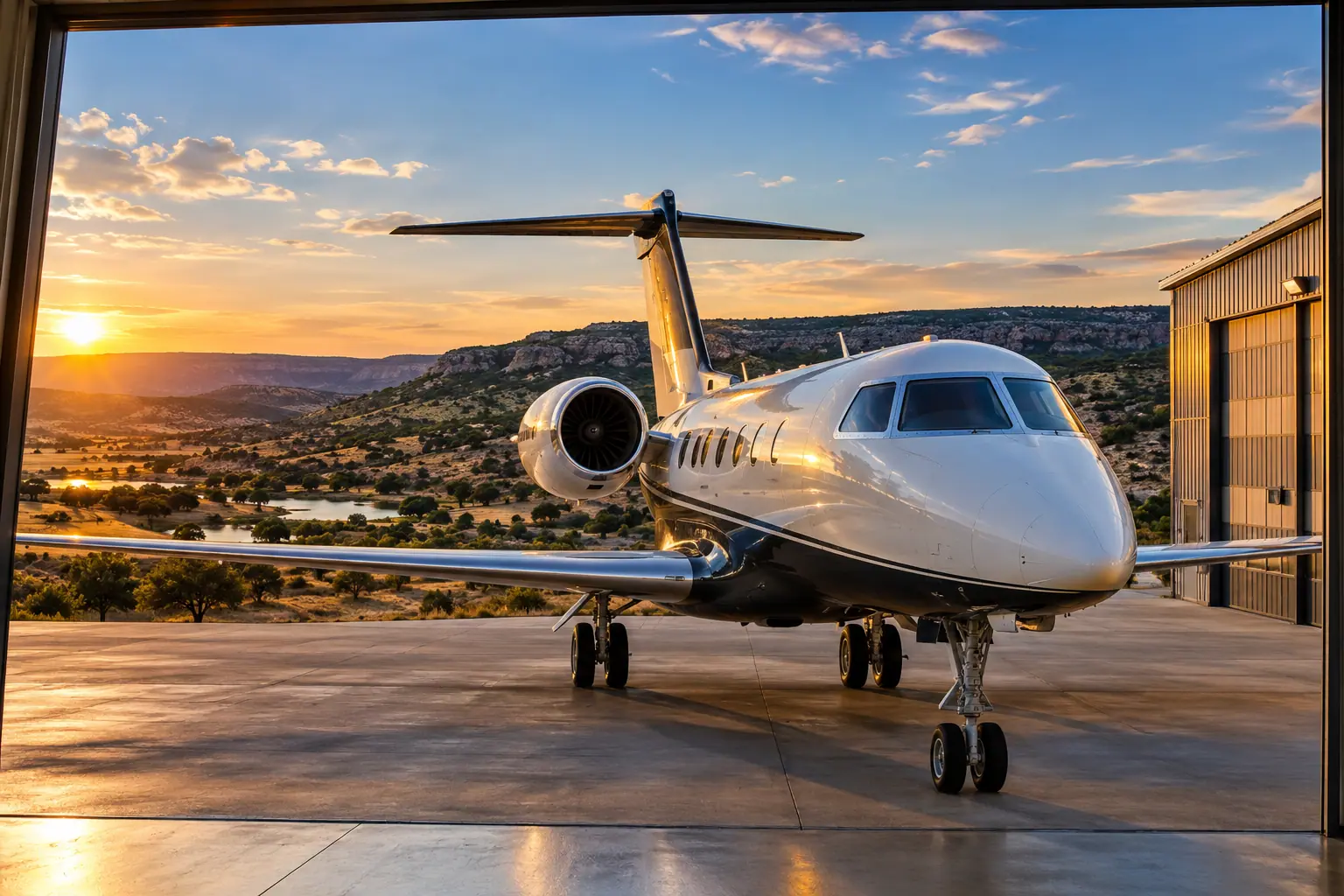
Runway length at Nighthawks Nest
The runway at Nighthawks Nest is 7,634 feet long, which is enough for many light and midsize jets at the field's 592-foot elevation. At 592 feet elevation, the 7,634-foot runway gives light jets a comfortable margin in most weather. In summer, density altitude rises to 3,200 feet in July and August, and peak conditions can produce 3,700 feet at 115°F. If you are flying a heavy light jet or a turboprop, then expect the operator to compute takeoff distance carefully and possibly limit fuel or bags. The field is not towered, so pilots coordinate on the common traffic frequency and need good visibility to land.
| Runway | Length | Width | Surface |
|---|---|---|---|
| 5/23 | 7,634 ft | 150 ft | Asphalt |
Ground services at Nighthawks Nest
There are no FBOs listed at Nighthawks Nest, so do not expect a staffed terminal or a dedicated crew car. Without an FBO at Nighthawks Nest, your operator will arrange any needed ground handling in advance. That could mean a local provider meets the aircraft, or the crew handles the turn with minimal support. Passengers should plan to board and deplane on the ramp and arrange their own transportation. If you need a full-service FBO with a lounge, you may prefer to use a larger airport in the San Antonio area.
When a private jet Nighthawks Nest
- Light jet and turboprop departures where a 7,634-foot runway and 592-foot elevation work for the aircraft.
- Travelers who value a small field with minimal ground congestion and are arranging their own ground transport.
- Shorter regional legs within Texas or nearby states, where the field's location west of San Antonio is convenient.
- Cooler-month flights when density altitude is lower and payload margins are better.
| Class | Typical runway need | Here |
|---|---|---|
| Turboprop | 3,300 ft+ | Fits |
| Light jet | 4,000 ft+ | Fits |
| Midsize jet | 5,000 ft+ | Fits |
| Super-midsize jet | 5,200 ft+ | Fits |
| Heavy jet | 5,600 ft+ | Fits |
Nighthawks Nest density altitude
Summer at Nighthawks Nest brings highs near 96°F in July and August, with density altitude averaging 3,200 feet and peaking at 3,700 feet at 115°F. In July, Nighthawks Nest density altitude averages 3,200 feet, which reduces performance for some light jets. If you are departing on a hot afternoon with a full load, then the operator may adjust fuel or passenger count to stay within limits. Spring and fall are milder: April averages 2,200 feet and October 2,300 feet. Winter offers the best performance, with January density altitude around 1,000 feet and highs near 63°F. Wet days are most common in May, with 15, so build in flexibility for thunderstorms.
| Month | Avg high | Wet days | Density altitude |
|---|---|---|---|
| Jan | 63°F | 8 | 1,000 ft |
| Feb | 67°F | 8 | 1,300 ft |
| Mar | 76°F | 10 | 1,900 ft |
| Apr | 81°F | 12 | 2,200 ft |
| May | 86°F | 15 | 2,500 ft |
| Jun | 93°F | 11 | 3,000 ft |
| Jul | 96°F | 7 | 3,200 ft |
| Aug | 96°F | 7 | 3,200 ft |
| Sep | 91°F | 10 | 2,900 ft |
| Oct | 83°F | 8 | 2,300 ft |
| Nov | 72°F | 9 | 1,600 ft |
| Dec | 66°F | 8 | 1,200 ft |
Getting to and from Nighthawks Nest
Nighthawks Nest is a general aviation field without airline service or a terminal, so access is by road and you should prearrange a car. Since Nighthawks Nest has no FBO, plan your ground transportation before you land. The airport is west of San Antonio, and the drive to downtown takes you through the Hill Country. Rideshare availability can be thin, so schedule a pickup or have your hotel arrange a car. If you need a full-service FBO with rental cars and a passenger lounge, then consider using San Antonio International or Stinson Municipal instead.
Private jet routes via Nighthawks Nest
These 6 private jet routes span 168 to 1,377 nautical miles, with one-way light jet estimates running $4,000 to $25,500.


Questions about this airport
What is the runway length at Nighthawks Nest for a private jet?
The runway is 7,634 feet long at an elevation of 592 feet. That length supports many light and midsize jets, though operators will compute performance for the day's temperature and weight. In summer, density altitude averages 3,200 feet in July and can reach 3,700 feet at 115°F, which reduces margins. Expect the pilot to adjust fuel or payload on hot afternoons, and plan early departures when possible.
Does Nighthawks Nest have an FBO for private jet charters?
No FBO is listed at Nighthawks Nest, so there is no staffed terminal, lounge, or crew car on the field. Your charter operator will arrange any ground handling with a local provider, or the crew will handle the turn. Passengers should expect to board on the ramp and arrange their own transportation. If you require full FBO services, then a larger airport like San Antonio International or Stinson Municipal is a better fit.
How far is Nighthawks Nest from Las Vegas for a private jet leg?
It is 1,087 miles from Nighthawks Nest to the Strip in Las Vegas. That distance is within range of many midsize jets and some light jets, though light jets may need a fuel stop depending on winds and payload. In summer, density altitude at Nighthawks Nest reaches 3,200 feet in July, so the operator may reduce weight to ensure takeoff performance. Plan the leg with your operator to confirm nonstop capability.
What is density altitude at Nighthawks Nest in summer?
July and August average a density altitude of 3,200 feet, with peak conditions reaching 3,700 feet at 115°F. Density altitude is a measure of how the air performs, and high values increase takeoff distance. If you are flying a light jet with a full load, then the operator may limit fuel or passengers to stay within runway limits. Scheduling an early morning departure helps because temperatures and density altitude are lower.
Who operates private jet Nighthawks Nest charters?
Charter flights are operated by independent FAA Part 135 operators who hold operational control, and our service acts as a broker under DOT Part 295. That means we arrange the flight but the operator is responsible for the aircraft and crew. For international legs, CBP handles customs, and TSA rules apply where relevant. We verify operator certificates before booking, and you receive the operator's details before the flight.
What other airports serve San Antonio for private jets?
San Antonio International (SAT) has two FBOs and an 8,505-foot runway, while Stinson Municipal (SSF) has one FBO and a 5,000-foot runway. Castroville Municipal (CVB) has a 5,001-foot runway and no FBO. Nighthawks Nest offers a 7,634-foot runway but no FBO, so it suits travelers who want a small field and can arrange ground transport. If you need full services, then SAT is the better choice.