
private jet New York to San Antonio
A private jet New York to San Antonio covers 1,377 nautical miles, about 1,585 statute miles. Midsize aircraft make that nonstop in roughly 3 hours 35 minutes. The trip rewards a little planning around which Texas airport you actually want.
Private jet pricing New York to San Antonio by aircraft
A private jet flying New York to San Antonio covers 1,377 nautical miles on a midsize jet in 3h 35m, with a one-way estimate of $18,500–$28,000.The numbers below are estimates for the whole aircraft, not per seat, and they swing with fuel, crew duty, ramp fees and how far out you book. Times are block times for the recommended class. Notice that the light jet and turboprop save money but give up the nonstop, which changes the day entirely.
| Aircraft class | Flight time | One-way estimate | Notes |
|---|---|---|---|
| Turboprop | 5h 52m | $13,000–$20,500 | Fuel stop likely |
| Light jet | 4h 25m | $17,000–$25,500 | Fuel stop likely |
| Midsize jet | 3h 35m | $18,500–$28,000 | Best fit |
| Super-midsize jet | 3h 23m | $24,500–$34,000 | Nonstop |
| Heavy jet | 3h 23m | $32,000–$49,000 | Nonstop |
Ballparks by aircraft, not by seat, prior to federal excise tax and segment fees. Duration covers taxi, climb and descent.
Why a midsize jet fits this trip
Midsize is the honest answer on this distance. A jet like the Hawker 800XP or Citation XLS+ carries eight passengers nonstop over 1,377 nm with range to spare, and the cabin is tall enough to stand a lean in for three and a half hours. A midsize jet covers New York to San Antonio nonstop in 3h 35m, so you land before lunch.
The alternatives are real but compromised. Light jets price from $17,000 but typically need a fuel stop, pushing the day past four and a half hours. Super-midsize and heavy jets shave only about ten minutes off the midsize time while adding $6,000 or more, which is hard to justify unless you need the cabin length or baggage volume. Turboprops make the trip but turn it into a six-hour affair.
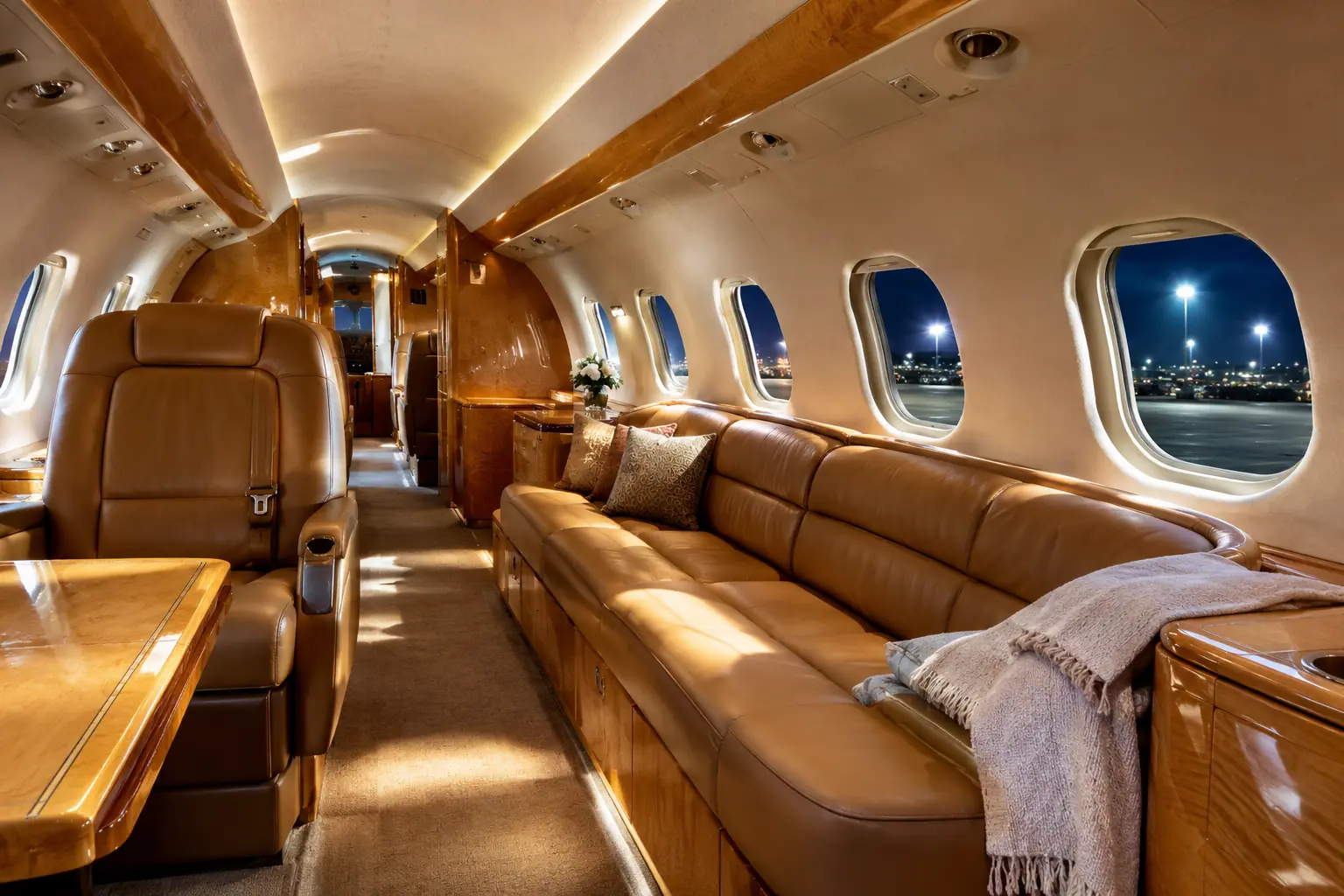
Hawker 800XP
- 8 seats
- 447 kt cruise
- 2,540 nm range
5 ft 9 in tall, 21 ft 4 in long cabin. 50 cu ft baggage.
Cessna Citation XLS+
- 8 seats
- 441 kt cruise
- 2,100 nm range
5 ft 8 in tall, 18 ft 6 in long cabin. 90 cu ft baggage.

Leaving the New York area
Most travelers start at Teterboro (KTEB) or Westchester County (HPN), the two business-aviation fields that keep you out of the airline terminals entirely. Teterboro's longest runway runs 6,997 ft and Westchester's 6,549 ft, both comfortable for a loaded midsize on a cool morning. From Teterboro or Westchester, a midsize jet reaches San Antonio in 3h 23m to 3h 35m depending on winds. Your operator files the route and handles the crew; you handle the coffee.
Arriving in San Antonio
San Antonio International (KSAT) is the usual arrival, with an 8,505 ft runway and full services, and it sits about 1,069 miles from the strip by road. Stinson Municipal (KSSF) is the closer-in general aviation field with a 5,000 ft runway, handy if your business is south of downtown. San Antonio International offers an 8,505 ft runway, which handles a midsize jet with margin even on a hot afternoon. Castroville and Nighthawks Nest are alternates when the city fields get congested.
| Airport | Code | Runway |
|---|---|---|
| Teterboro Airport | KTEB / TEB | 6,997 ft |
| Westchester County Airport | KHPN / HPN | 6,549 ft |
| Stinson Municipal Airport | KSSF / SSF | 5,000 ft |
| San Antonio International Airport | KSAT / SAT | 8,505 ft |
| Nighthawks Nest Airport | TT45 | 7,634 ft |
| Castroville Municipal Airport | KCVB | 5,001 ft |
When prices peak on this route
Demand into San Antonio climbs around major conventions, the winter livestock and rodeo season, and anytime a large meeting lands downtown. Return legs back to New York tighten on Sunday evenings and Monday mornings, when business travelers want to be home or at the desk. Book at least a week ahead for weekday departures, because midsize availability on this 1,377 nm leg dries up fast.
Same-day round trips are possible but expensive: you pay for crew duty and often for the aircraft to wait. If your schedule allows an overnight, the pricing usually improves. Summer afternoons in San Antonio get hot enough to matter for performance, so earlier arrivals are kinder to the airplane and the passengers alike.
Private jet routes similar to New York to San Antonio
These 6 private jet routes span 1,061 to 1,553 nautical miles, with one-way midsize jet estimates running $14,500 to $31,000.
Philadelphia → San Antonio
- 3h 27m
- $18,000–$27,000
- 1,320 nm
San Francisco → San Antonio
- 3h 23m
- $17,500–$26,500
- 1,292 nm
Boston → San Antonio
- 3h 57m
- $20,500–$31,000
- 1,529 nm
Seattle → San Antonio
- 4h 00m
- $21,000–$31,000
- 1,553 nm
Washington, DC → San Antonio
- 3h 08m
- $16,500–$24,500
- 1,189 nm
Los Angeles → San Antonio
- 2h 50m
- $14,500–$22,000
- 1,061 nm
Questions about this route
How long is a private jet New York to San Antonio flight?
A midsize jet flies the route nonstop in about 3 hours 35 minutes over 1,377 nautical miles. Super-midsize and heavy aircraft come in near 3 hours 23 minutes. Light jets typically require a fuel stop and run closer to 4 hours 25 minutes, and turboprops take roughly 5 hours 52 minutes.
What does a private jet New York to San Antonio cost?
Estimates for a midsize jet run from $18,500 to $28,000 for the whole aircraft, not per seat. Light jets start around $17,000, super-midsize from $24,500 and heavy jets from $32,000. These are estimates; fuel, crew time, airport fees and booking lead time all move the final number.
Which San Antonio airport will my flight use?
Most arrivals use San Antonio International (KSAT) with its 8,505 ft runway, or Stinson Municipal (KSSF) closer to downtown with 5,000 ft. Castroville Municipal and Nighthawks Nest serve as alternates. Your operator picks based on runway length, ramp fees and where you are actually going.
Can I fly this route nonstop?
Yes, in a midsize jet or larger. The 1,377 nm distance is within the range of a Hawker 800XP (2,540 nm) and Citation XLS+ (2,100 nm) with full passengers and baggage. Light jets and turboprops generally need a fuel stop, which adds time and a second landing fee.
Who operates the aircraft and who am I contracting with?
The flight is flown by an operator holding FAA Part 135 authority, and that operator holds operational control of the aircraft and crew. A broker arranging your trip acts as an agent under DOT Part 295. Ask for the operator's name and certificate before you book, and confirm insurance limits in writing.
Is a same-day round trip realistic?
It is possible but rarely economical. A round trip means paying for the aircraft and crew to wait in San Antonio, plus duty-time limits on the pilots. If your meeting is short, an overnight often prices better than a same-day turn, and it keeps the crew legal for the return.