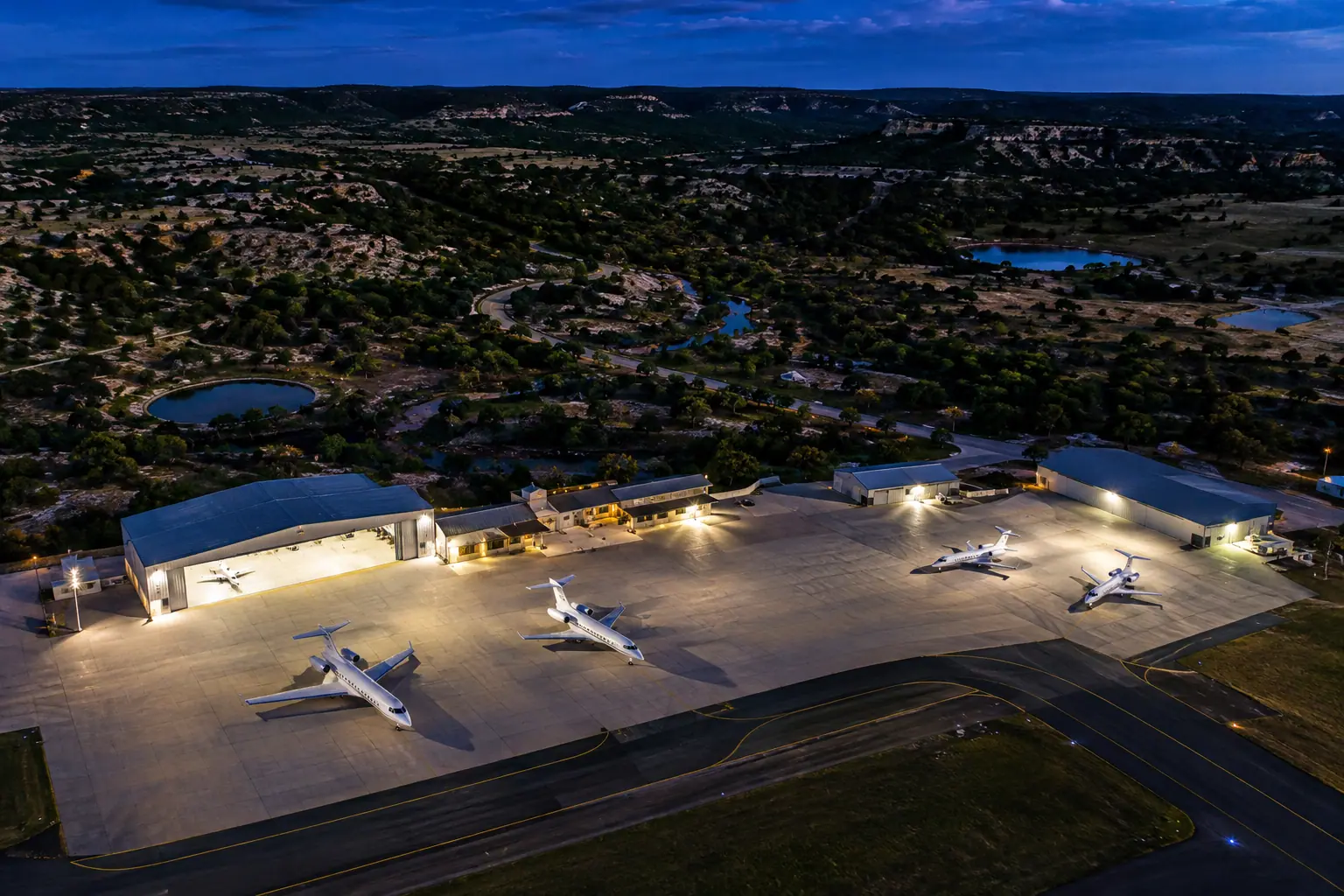
Private jet charter San Antonio
This guide covers the airports, runways and summer conditions behind a private jet charter San Antonio travelers actually book. SAT sits at 809 ft with an 8,505-ft runway and two on-field FBOs. Charter means a broker arranging flights for operators, not owning aircraft.
A private jet charter San Antonio request usually resolves to one question: which airport, and on what day. San Antonio International Airport (SAT/KSAT) handles the bulk of turbine traffic, sitting at 809 ft elevation with an 8,505-ft main runway that clears any midsize or large-cabin type on a hot afternoon. The relievers — Stinson Municipal, Castroville, and the private strip at Nighthawks Nest — change the calculus for lighter aircraft, shorter hops and drive times, especially when you're weighing a private charter flight from San Antonio against a scheduled seat on the same city pair.
The operator flying you holds FAA Part 135 certification and operational control. Your broker arranges the flight and acts as your agent under DOT Part 295 rules, which is why the quote you get should name the operating certificate, the tail number and the aircraft type in writing before you commit. Prices you see quoted for a route are estimates and move with fuel, crew duty time and how close to departure you book. Ask what's included: crew overnight, ramp fees, catering and de-icing all show up somewhere, and the operator's quote language decides where. Charter quotes for San Antonio flights should name the operator, tail and price inclusions up front.
Typical traveler reasons drive most of the demand: energy and healthcare business downtown, military and contractor travel around Joint Base San Antonio, and leisure trips to the Hill Country, South Texas ranches or the coast. Some routes are simply better flown than driven — roughly 1,069 miles to the Strip puts Las Vegas in range for a light or midsize jet with a fuel stop on a winter headwind, while shorter hops to Dallas or Houston suit anything in the fleet. If your group carries golf clubs, medical equipment or a pet, say so when you request the quote, because cabin and baggage volume vary sharply across airframes. For San Antonio routes, aircraft choice matters more than the hourly number.
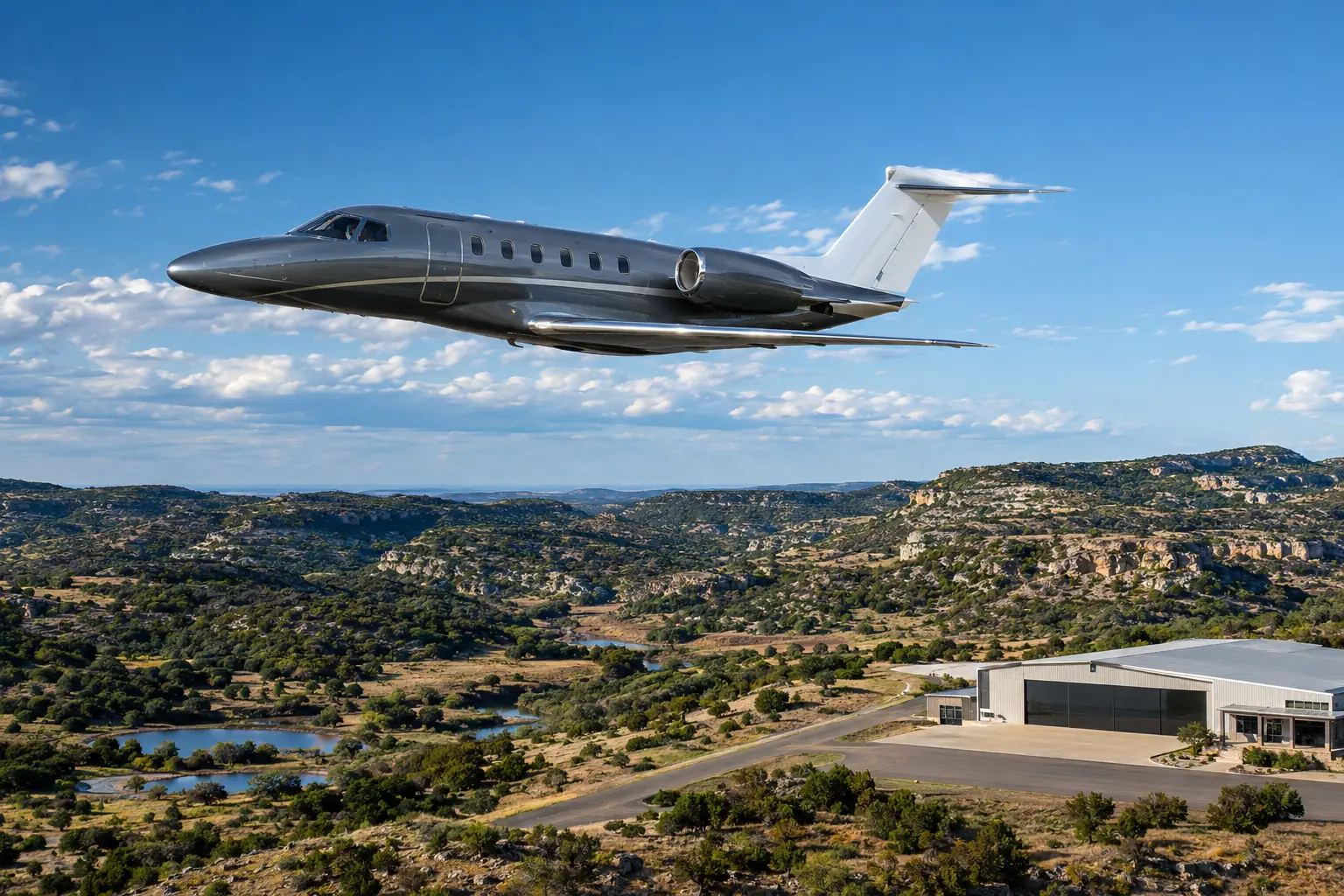
Runways and field conditions at SAT
SAT's longest runway measures 8,505 ft at 809 ft field elevation, which is generous for the region and covers large-cabin jets departing hot. Stinson Municipal (SSF) is the closer-in reliever at 577 ft elevation with a 5,000-ft runway, fine for light and some midsize aircraft but a real constraint on a July afternoon — at Stinson's 5,000-ft runway, summer heat is the limiting factor. Castroville Municipal sits at 771 ft with 5,001 ft of runway, and Nighthawks Nest at 592 ft with 7,634 ft, though it lists no FBO on field, so ground handling has to be arranged. Castroville's 771-ft elevation and 5,001-ft runway suit light jets on cooler days.
Runway length alone doesn't decide whether your aircraft can depart. Obstacle clearance, climb gradient, brake energy and the operator's own performance numbers all enter the takeoff calculation, and on a 96-degree July afternoon a light jet that leaves easily in January may need a payload cut. If your trip involves a short-field destination on the other end, then the departure airport choice affects what can be loaded, so tell your broker the full route rather than just the first leg. Tell the broker the whole route, not just the departure airport.
| Runway | Length | Width | Surface |
|---|---|---|---|
| 04/22 | 8,505 ft | 150 ft | Concrete |
| 13R/31L | 8,502 ft | 150 ft | Concrete |
| 13L/31R | 5,519 ft | 100 ft | Asphalt |
FBOs and ground handling at SAT
San Antonio International has two on-field FBOs, Velocity FBO and Signature Aviation, both of which handle transient turbine traffic with ramp access, lounges and crew facilities. Which one your flight uses depends on the operator's contract, so confirm the location before you send a car — the two are on the airport but not at the same address. Velocity FBO and Signature Aviation both serve SAT transient jet traffic.
Stinson Municipal lists GateOne as its FBO. Castroville and Nighthawks Nest list none, which means fuel and handling are arranged case by case, and you should expect that to appear as a line item. If your itinerary includes an international return, then CBP clearance needs to be built into the plan at a port of entry, and the operator should confirm that arrangement rather than leaving it to the FBO. For international legs, CBP clearance is planned in advance, not assumed.
What this airport is best for
- Business travel downtown and to the Medical Center, with SAT's two FBOs and short taxi to the terminal area
- Large-cabin and long-range departures that need the full 8,505 ft of runway in summer heat
- Military and contractor travel tied to Joint Base San Antonio, where schedules change late
- Groups heading to Hill Country ranches, South Texas hunting leases or the coast with gear in the hold
| Class | Typical runway need | Here |
|---|---|---|
| Turboprop | 3,300 ft+ | Fits |
| Light jet | 4,000 ft+ | Fits |
| Midsize jet | 5,000 ft+ | Fits |
| Super-midsize jet | 5,200 ft+ | Fits |
| Heavy jet | 5,600 ft+ | Fits |
Heat and density altitude by season
Density altitude at SAT climbs from roughly 1,300 ft in January to about 3,500 ft on a typical July afternoon, and peaks near 4,000 ft in extreme heat, which is the number that quietly governs summer payload. That's the figure to ask about when a quote comes in higher than expected in mid-summer; performance-limited takeoffs can mean a fuel stop or a lighter load, and both cost money. At SAT, a 4,000-ft peak density altitude reshapes summer takeoff planning.
Wet days cluster in spring and early fall — May is the wettest month in this data at 15 days — while July and August dry out to 7 wet days each with highs around 96 F. If your trip falls in the spring storm window, then an early morning departure gives you cooler air and a better chance of clear of convective buildup. Winter flying here is mild at 63 to 67 F highs, though the occasional blue norther can bring wind and a brief freeze that affects de-icing availability. Spring trips from San Antonio benefit from morning departures and flexible timing.
| Month | Avg high | Wet days | Density altitude |
|---|---|---|---|
| Jan | 63°F | 8 | 1,300 ft |
| Feb | 67°F | 8 | 1,500 ft |
| Mar | 76°F | 10 | 2,100 ft |
| Apr | 81°F | 12 | 2,500 ft |
| May | 86°F | 15 | 2,800 ft |
| Jun | 93°F | 11 | 3,300 ft |
| Jul | 96°F | 7 | 3,500 ft |
| Aug | 96°F | 7 | 3,500 ft |
| Sep | 91°F | 10 | 3,100 ft |
| Oct | 83°F | 8 | 2,600 ft |
| Nov | 72°F | 9 | 1,900 ft |
| Dec | 66°F | 8 | 1,500 ft |
Getting to and from the field
SAT sits about 8 miles north of downtown off US 281 and Loop 410, a straightforward drive from the River Walk, Pearl District and the Medical Center, with the two FBOs reached by separate airport roads. Stinson Municipal is south of downtown near the missions, closer for some South Side addresses. If you're arriving on a tight schedule, then confirm the FBO with your broker before departure so your driver isn't sent to the wrong side of the field. Confirm the FBO before you dispatch a car to SAT.
Private jet routes via San Antonio
These 6 private jet routes span 168 to 1,377 nautical miles, with one-way light jet estimates running $4,000 to $25,500.


Questions about this airport
Where does private jet charter San Antonio traffic usually fly from?
Most flights use San Antonio International (SAT/KSAT), which has an 8,505-ft runway at 809 ft elevation and two on-field FBOs. Stinson Municipal is the closer-in reliever with a 5,000-ft runway, better for light jets on cooler days. Castroville and Nighthawks Nest serve as alternates when Stinson's runway length or ground handling doesn't fit your aircraft.
How much does a private jet charter from San Antonio cost?
Quotes are estimates and vary with aircraft, fuel, crew duty time and how far ahead you book, so there's no fixed figure. The number that matters is the all-in one: ask whether ramp fees, catering, crew overnight and any fuel stop are inside it. The distance to the Strip is about 1,069 miles, which gives you a rough sense of category for that route.
Can a light jet depart SAT in July heat?
Often, but the numbers tighten. Typical July density altitude at SAT runs near 3,500 ft, and extreme heat pushes it toward 4,000 ft. On the 8,505-ft runway most light and midsize types still depart, though payload or fuel may be reduced. If the aircraft is weight-limited, then a fuel stop or a lighter load is the usual answer.
Does San Antonio International have customs for international returns?
International arrivals need CBP clearance built into the itinerary at a designated port of entry, and that's arranged in advance through the operator rather than assumed at the FBO. If your trip ends with a return from Mexico or the Caribbean, then raise it when you request the quote so the routing and timing account for clearance and any repositioning.
Who is responsible for the flight I book?
The operator flying you holds FAA Part 135 certification and operational control of the aircraft and crew. A broker arranging the flight acts as your agent under DOT Part 295. That split matters: ask for the operating certificate and tail number in writing. If a quote won't name the operator, then treat that as a reason to keep comparing options.
Which San Antonio airport is better for a short hop to Dallas or Houston?
Either SAT or Stinson works, and the choice usually comes down to your address and the aircraft. SAT has the longer runway and two FBOs; Stinson is closer to the South Side and missions area but caps you at 5,000 ft of runway. If your aircraft is a light jet and the day is cool, then Stinson can save drive time.